

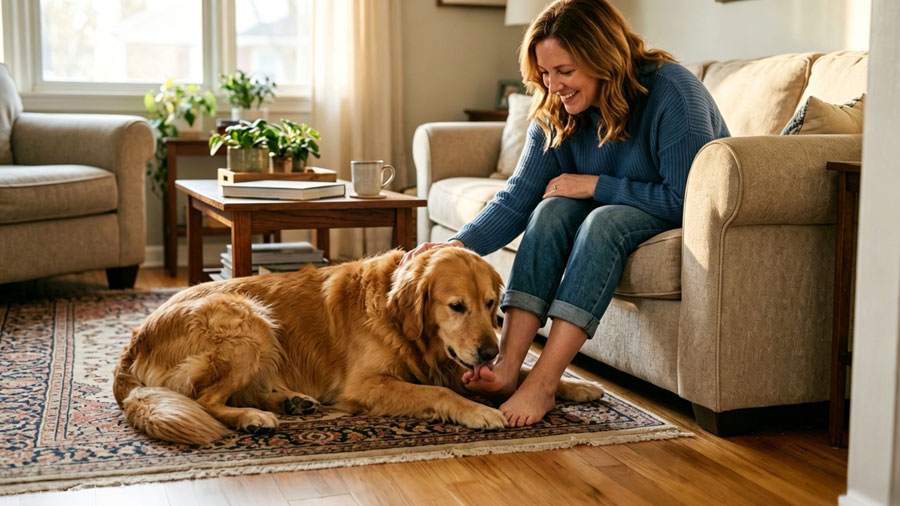
You kick off your shoes, and your dog is already on the floor — tongue out, zeroed in on your feet. Sound familiar? If you’ve ever asked why do dogs lick my feet, you’re not alone. The behavior is common, often harmless, but sometimes a signal worth paying attention to. This guide breaks down the 7 real reasons behind it, tells you when it’s a problem, and gives you a concrete plan to stop it if you want to.
Is Foot-Licking Normal Dog Behavior?
Short answer: yes, in most cases. Dogs use their mouths and noses to explore the world the way we use our hands and eyes. Licking is a core part of how they communicate, gather information, and self-regulate. The American Kennel Club notes that licking is one of the most instinctive behaviors in domestic dogs, rooted in everything from early puppyhood bonding to adult social signaling.
That said, normal and excessive are two very different things. Context matters.
7 Reasons Your Dog Licks Your Feet
1. Your Feet Are a Scent Encyclopedia
Your dog’s nose contains up to 300 million olfactory receptors — compared to roughly 6 million in humans. But smell isn’t just about the nose. Dogs have a second sensory organ called the vomeronasal organ (also known as Jacobson’s organ), located in the roof of the mouth, which detects pheromones and chemical signals invisible to us.
Your feet, especially after a long day, are loaded with sweat, dead skin cells, trace chemicals from wherever you’ve walked, and your unique biological scent signature. To your dog, one good lick is basically reading your entire daily diary.
how dogs process scent through the vomeronasal organ
2. It’s Affection — Plain and Simple
Mother dogs lick their puppies from birth to clean them, stimulate circulation, and bond. That wiring doesn’t disappear in adult dogs. When your dog licks you, it’s drawing on the same deeply embedded behavior that says you matter to me.
Feet may seem like a strange target for affection, but they’re simply the most accessible part of you when your dog is at floor level. Don’t overthink it — this one is just love.
3. You Just Got Home and They’re Debriefing You
This is especially common when your dog licks your feet the moment you walk through the door. They’re not just excited — they’re gathering intel.
The pheromones and scent traces on your shoes and feet carry information about everywhere you’ve been. Did you pet another dog? Walk through a park? Stop somewhere unfamiliar? Your dog can detect all of it. The licking is less a greeting and more a full debrief.
understanding your dog’s body language when you come home
4. You Taught Them To (Without Realizing It)
Here’s one most people miss. The first time your dog licked your feet, what did you do? You probably laughed, pulled your feet away, maybe said “stop it!” — all of which, from your dog’s perspective, counts as getting your attention.
In behavioral terms, this is operant conditioning. Your reaction — even a negative one — reinforced the behavior. The dog learned: licking feet = human responds. They’ll keep doing it as long as that equation holds.
5. It’s Self-Soothing — and Sometimes a Red Flag
Licking releases endorphins. For dogs, it’s a built-in calming mechanism. A dog that’s mildly anxious, bored, or overstimulated may lick your feet simply because it feels good and settles their nerves.
The distinction between occasional self-soothing and compulsive behavior is important. Use this table to assess where your dog falls:
| Signal | Normal Licking | Needs Attention |
|---|---|---|
| Frequency | Situational (post-walk, greeting) | Daily, prolonged, hard to interrupt |
| Can be redirected? | Yes, easily | Rarely — resumes immediately |
| Triggers | Clear (you arrive home, post-shower) | Random, no obvious cause |
| Accompanying behaviors | Relaxed body, wagging tail | Panting, pacing, whining |
| Impact on daily routine | None | Affects sleep, eating, or play |
If three or more columns on the right apply, talk to your vet. Compulsive licking can be a sign of anxiety disorders, OCD-like behavior in dogs, or an unmet environmental need.
6. Some Breeds Are Just More “Mouthy”
Breed plays a real role here. Retrievers — Labrador, Golden, Flat-Coated — were selectively bred to use their mouths gently and frequently. Beagles and other scent hounds are orally exploratory by nature. Herding breeds like Border Collies may lick as a form of low-level contact behavior.
If you have a retriever and you’re wondering why your dog specifically won’t leave your feet alone, breed instinct is likely a big part of the answer. It’s not a flaw — it’s what they were built to do.
Puppies also lick more than adult dogs as a rule. It’s how they explore their world before they’ve built other coping and communication tools. Most dogs naturally reduce the behavior as they mature, provided it isn’t reinforced.
7. You Taste Good (Especially After Exercise)
Sweat contains sodium, lactic acid, and trace minerals. To a dog, salty skin is genuinely appealing — not metaphorically, but in the same direct way a salty snack appeals to you. Post-gym, post-run, or on a hot day, you’re basically a walking lick mat.
Some moisturizers, sunscreens, and body lotions also carry scents that attract dogs. Worth keeping in mind (and worth checking labels — more on that in the next section).
Is It Safe to Let Your Dog Lick Your Feet?
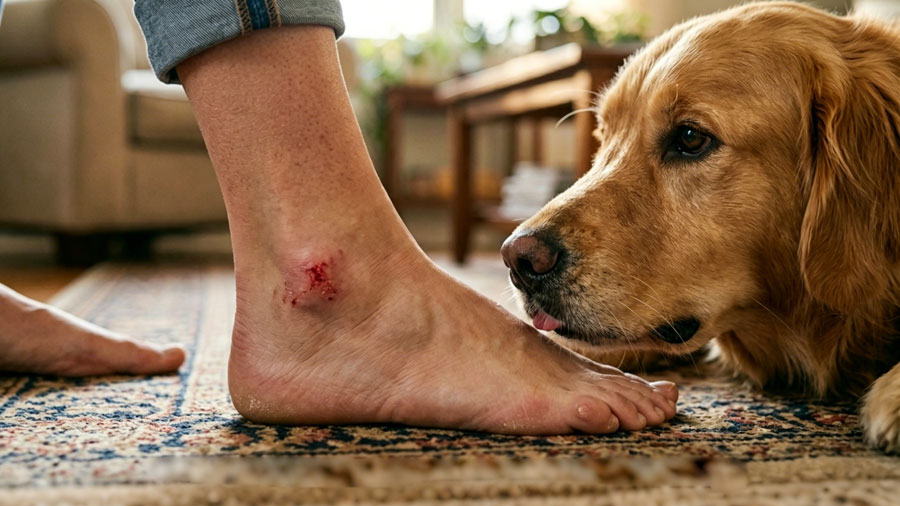
For most healthy adults with intact skin, occasional foot licking is low-risk. But there are specific situations where you should stop it.
Risks for Humans
- Open wounds or broken skin: Dog saliva contains bacteria including Pasteurella and Capnocytophaga canimorsus. On unbroken skin, these are generally harmless. On a cut or abrasion, they can cause infection — occasionally serious ones, particularly in immunocompromised individuals.
- Fungal infections (athlete’s foot): If you have active tinea pedis, your dog licking your feet creates a transmission risk — to them, not just you.
- Vulnerable populations: Older adults, pregnant people, and anyone on immunosuppressive medication should be more cautious about animal saliva contact with skin.
Risks for Your Dog
This one surprises most people. Foot licking is riskier for your dog than for you in some scenarios:
- Topical products: Sunscreen, antifungal creams, and certain moisturizers contain compounds that can be toxic to dogs if ingested. Zinc oxide, common in sunscreens, is a known toxin for dogs.
- Floor chemicals: Household cleaners, lawn treatments, and de-icing salts on sidewalks all leave residue on floors — and on your feet. Your dog licking your feet after you’ve walked on a freshly mopped floor can ingest those chemicals.
toxic substances in common household products for dogs
The bottom line: Healthy adult, no skin breaks, no chemical exposure on your feet? Low risk. Any of the above apply? Stop it — for both your sakes.
When Should You Actually Be Worried?
Beyond the safety checklist, watch for these behavioral red flags:
- Licking lasts more than 5–10 minutes at a stretch
- Happens multiple times daily regardless of context
- Your dog cannot be distracted or redirected
- It started suddenly with no obvious trigger (new home, new family member, schedule change)
- Accompanied by other anxious behaviors: destruction, excessive barking, or clinginess
If you check three or more: Schedule a vet visit. Ask specifically about anxiety-related compulsive behaviors and whether a referral to a veterinary behaviorist makes sense. This isn’t something to manage with training alone.
How to Stop Your Dog From Licking Your Feet
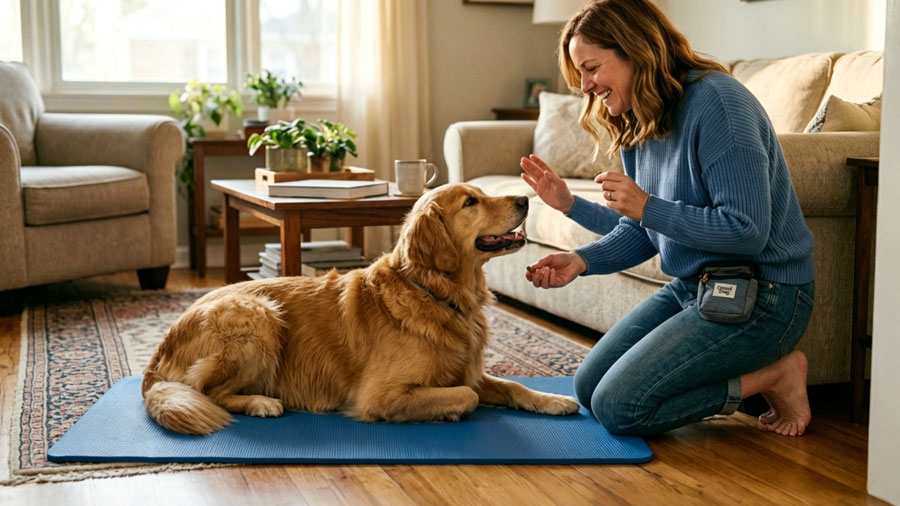
Telling a dog to “just stop” doesn’t work. Here’s a framework that does.
Step 1: Remove the Opportunity (Management First)
Before any training starts, manage access. Wear socks or shoes in the house during training. If your dog can’t reach your feet, they can’t practice the behavior — and what dogs practice, they get better at. This isn’t the solution; it’s the foundation.
Step 2: Redirect — Don’t Just Ignore
A common mistake: owners try to ignore the licking and do nothing. The problem is that ignoring can trigger an extinction burst — the behavior temporarily gets worse before it fades, because the dog escalates to see if more effort gets a response.
Instead, redirect before the licking starts. The moment your dog approaches your feet with that look, hand them a lick mat, a stuffed Kong, or a chew toy. You’re not rewarding the licking — you’re replacing the behavior before it happens.
Step 3: Reinforce an Incompatible Behavior
Teach your dog a specific alternative: “go to your place” (a mat or bed nearby). When you sit down, cue the behavior, reward them for staying on the mat, and gradually extend the duration. A dog lying on their mat cannot simultaneously lick your feet.
Consistency across all household members is non-negotiable. One person allowing it while others don’t will stall progress for weeks.
Most dogs show meaningful improvement within 2–4 weeks of consistent application.
FAQ
Why does my dog lick my feet obsessively and won’t stop?
Obsessive licking that can’t be interrupted usually points to anxiety, under-stimulation, or compulsive behavior. Check for other stress signals (pacing, panting, destructiveness). If present, consult a vet — training alone won’t resolve an anxiety-based compulsion.
Why does my dog lick my feet when I get home?
They’re collecting scent data on where you’ve been, not just greeting you. It’s normal debrief behavior. If it bothers you, redirect immediately with a toy or a sit/stay command before they reach your feet.
Is it unsanitary to let my dog lick my feet?
For healthy adults with no skin breaks and no topical products on their feet, the risk is low. It becomes a real concern with open wounds, immunocompromised individuals, or chemical residue on skin.
Do certain dog breeds lick feet more than others?
Yes. Retrievers (Labrador, Golden), scent hounds (Beagle), and some herding breeds tend to be more orally exploratory. It’s a breed tendency, not a behavioral problem — but it can still be redirected with consistent training.
Why does my dog lick my feet at night?
Nighttime licking is often self-soothing. Your dog may use the familiar scent and the rhythm of licking to wind down. If it’s disturbing your sleep, redirect them to their own sleeping space before the behavior starts.
Final Thoughts
Most dogs lick feet because they love you, because you’re interesting, or because you accidentally trained them to. It’s usually harmless. But usually isn’t always — and knowing the difference between normal canine affection and a behavior worth addressing is what good ownership looks like. If something feels off, trust that instinct and get a professional opinion.
Disclaimer: This article is for informational purposes only and does not constitute veterinary advice. If your dog shows signs of compulsive behavior, sudden behavioral changes, or you have concerns about their health, consult a licensed veterinarian or certified veterinary behaviorist.