

Your dog just destroyed the couch—again. Or snapped at a guest for no obvious reason. Before you Google “dog training tips,” consider this: the psychology of dogs may explain why it happened far better than any command-based fix ever could. This guide breaks down canine cognition, emotions, and body language using current behavioral science—so you can stop guessing and start actually understanding your dog.

What Is the Psychology of Dogs — And Why Does It Matter?
Dog psychology is the study of how dogs think, feel, and make decisions. It’s not the same as dog training. Training teaches a dog what to do. Psychology explains why they do anything at all.
That distinction matters more than most owners realize.
A dog that barks relentlessly, chews furniture, or lunges on the leash isn’t being defiant. It’s communicating. And if you only respond with commands — “sit,” “no,” “stop” — without addressing the underlying emotional state, you’re treating the symptom and ignoring the cause.
According to the American Veterinary Medical Association (AVMA), behavioral problems are one of the leading reasons dogs are surrendered to shelters each year. Many of those dogs weren’t broken. Their owners just didn’t have the tools to understand them.
AVMA’s resources on animal behavior and welfare
Psychology first. Training second. That order changes everything.
How Dogs Think: The Science Behind the Canine Mind
Do Dogs Actually Have Emotions?
For decades, mainstream science resisted attributing emotions to animals. That position has largely collapsed.
Neuroscientist Gregory Berns at Emory University trained dogs to sit still in an MRI scanner — without sedation — and measured their brain activity. His findings: the caudate nucleus, the brain region associated with reward and positive emotion in humans, lit up in dogs when they smelled their owners. Same region. Same pattern.
Dogs don’t just behave as if they feel things. They neurologically respond the way emotionally capable beings do.
Psychologist Stanley Coren at the University of British Columbia has estimated that dogs have the emotional range of a 2- to 2.5-year-old child — capable of joy, fear, anger, disgust, and love, but likely not complex social emotions like guilt or shame (more on that in the FAQ).
Why Dogs Don’t Think Like Us
Here’s where owners go wrong most often: projecting human reasoning onto dogs.
Dogs live in a sensory world dominated by smell, not sight. They have roughly 300 million olfactory receptors; humans have about 6 million. What your dog “sees” when it enters a room is actually a dense chemical map of everything that happened there.
Dogs also don’t plan revenge. They don’t sulk strategically. The chewed shoe you found when you got home wasn’t punishment for leaving — it was boredom, anxiety, or a conditioned habit. Dogs process time differently, and a behavior that happened three hours ago carries no moral weight for them in the present moment.
This is also why generalization is so difficult for dogs. A dog trained to sit in your kitchen may genuinely not understand that “sit” applies in the park. The brain of a dog links commands to context tightly. Teaching a behavior means repeating it across enough different environments until the abstraction clicks. That’s not stubbornness — it’s how canine cognition works.
Reading Dog Body Language: A Practical Field Guide
Most dog bites don’t come out of nowhere. The dog warned. The human missed it.
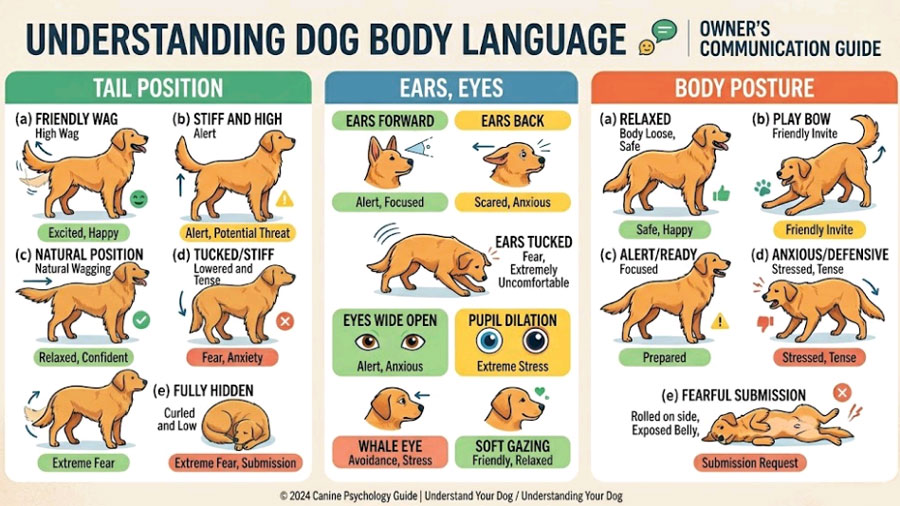
Body language is the primary language dogs use. Learning to read it isn’t a nice-to-have skill — it’s essential for safety and relationship-building.
What the Tail Is Actually Saying
A wagging tail doesn’t automatically mean a happy dog. Pay attention to:
- Height: A tail held high and stiff signals arousal or dominance. A tucked tail signals fear or submission.
- Speed: A slow, low wag often means uncertainty. A fast, loose wag with a wiggly body is genuine happiness.
- Direction: Research from the University of Trento found that dogs wag slightly more to the right when they see their owner, and more to the left when facing something threatening. Subtle, but measurable.
Eyes and Ears
- Soft eyes (relaxed, slightly squinting): comfort and trust
- Hard eyes (wide, fixed stare): a warning; don’t push further
- Whale eye (whites visible at the corners): stress or conflict — back off
- Ears forward: alert and engaged
- Ears pinned back: fear, submission, or appeasement
Full-Body Posture
Never read one signal in isolation. A wagging tail on a stiff body means something very different from a wagging tail on a loose, wiggly body. Look at the whole dog.
Calming signals — yawning, lip licking, turning the head away, sniffing the ground mid-interaction — are a dog’s way of saying “I’m uncomfortable, can we dial this back?” Most people ignore them entirely and then wonder why the dog “suddenly” snapped.
Pack Mentality: What the Science Actually Says
The idea that you need to “dominate” your dog to establish leadership comes from a 1970s study on captive wolves — a study whose own author, David Mech, has spent decades trying to retract.
Wild wolf packs aren’t rigid dominance hierarchies. They’re family units. Parents lead through experience and guidance, not force. Domestic dogs diverged from wolves thousands of years ago and have evolved specifically to read and respond to humans. Applying wolf-pack dominance theory to your Labrador is, scientifically speaking, a stretch.
What dogs actually need from you isn’t dominance. It’s predictability.
Consistent routines. Clear rules applied consistently. A calm, stable presence when they’re uncertain. That’s what effective leadership looks like for a domestic dog — and it works precisely because it addresses how dogs actually process their social environment.
how to establish consistent routines for anxious dogs
Dog Psychology vs. Dog Training: You Need Both
| Dog Psychology | Dog Training | |
|---|---|---|
| Focuses on | Why (motive, emotion, need) | How (behavior, command, technique) |
| Goal | Mental balance and emotional health | Reliable response to cues |
| Tools | Observation, assessment, environment | Reinforcement, repetition, reward |
| Used alone | Understanding without execution | Compliance without understanding |
| Best practice | ✅ Always pair with training | ✅ Always ground in psychology |
A dog that knows “sit” but lunges at strangers hasn’t failed at training. The training was just applied without addressing what’s driving the lunge — most likely fear, frustration, or unmet social needs.
Psychology tells you what the dog needs. Training gives you the tools to deliver it. Remove either one and results plateau.
Applying Dog Psychology Day-to-Day
The Observe–Assess–Respond Framework
Before reacting to unwanted behavior, run through three quick questions:
- Observe: What is the dog actually doing, and what triggered it?
- Assess: What emotional state is driving this — fear, boredom, overstimulation, physical discomfort?
- Respond: Address the root cause, not just the surface behavior.
A dog barking at the window isn’t “being bad.” It may be under-stimulated, anxious, or performing a self-reinforcing territorial ritual. Each cause has a different fix.
Breed Psychology Is Not One-Size-Fits-All
A Border Collie without a mental job will dismantle your home. A Basset Hound will not. That’s not a personality difference — it’s a neurological one. Working and herding breeds have been selectively developed for drive, focus, and sustained mental engagement. Companion breeds were not.
Understanding your dog’s breed group tells you a lot about their default psychological needs:
- Herding breeds (Border Collie, Aussie): need problem-solving tasks and directional work
- Scent hounds (Beagle, Bloodhound): need nose-based enrichment; sniff walks matter more than sprint walks
- Terriers: high prey drive, independent thinkers, need outlets for that energy
- Toy breeds: often more anxious than size suggests; need consistent structure, not coddling
Daily Habits That Support Mental Health
- Sniff walks over speed walks: letting your dog stop and smell isn’t wasted time — it’s neurologically enriching. A 20-minute sniff walk tires a dog more than a 45-minute jog.
- Predictable schedules: feeding, walking, and sleep at consistent times reduce baseline anxiety significantly.
- Mental enrichment: puzzle feeders, nose work games, and short daily training sessions (5–10 minutes) keep the canine brain engaged and reduce boredom-based destruction.
When to Get Professional Help — And Who to Call
Not every behavior problem resolves with YouTube videos and patience. Know the difference between these three types of professionals:
| Professional | Credential | Best For |
|---|---|---|
| Dog Trainer | CPDT-KA | Obedience, basic behavior, manners |
| Applied Animal Behaviorist | CAAB / ACAAB | Complex behavioral issues, fear, reactivity |
| Veterinary Behaviorist | DACVB | Severe anxiety, aggression with medical overlap, medication management |
Seek professional help immediately if your dog:
- Has bitten someone and broken skin
- Shows escalating aggression despite consistent training efforts
- Displays severe separation anxiety (self-injury, inability to eat or settle)
- Experiences sudden, unexplained behavioral changes (often a medical signal)
⚠️ Important: Internet content — including this article — should never replace a professional evaluation when a dog is showing dangerous or severely distressed behavior. A board-certified veterinary behaviorist (DACVB) is the highest standard of care for complex behavioral cases.
find a certified applied animal behaviorist near you
FAQ: Psychology of Dogs
Can dogs sense human emotions?
Yes — and with notable accuracy. Dogs read facial expressions, body posture, and chemical changes in human scent (stress hormones are detectable). Multiple studies confirm dogs respond differently to calm vs. anxious owners, often mirroring the emotional state they detect.
Do dogs feel guilt, or is that a human projection?
Research by Alexandra Horowitz at Barnard College suggests what looks like “guilt” — the lowered head, averted eyes, tucked tail — is actually a response to your tone and body language, not the act itself. Dogs associate your reaction with the moment, not with what they did earlier. The “guilty look” appears whether or not the dog actually misbehaved.
What’s the difference between dog psychology and dog behavior?
Behavior is observable and measurable. Psychology attempts to explain the internal states — thoughts, emotions, motivations — that drive behavior. Scientists prefer “behavior” because it’s quantifiable. In practice, understanding both gives you a more complete picture.
How does past trauma affect a dog’s psychology?
Early negative experiences — abuse, neglect, lack of socialization — create lasting neurological patterns. A dog that was punished harshly as a puppy may show fear-based aggression years later with no obvious trigger. These dogs can improve significantly with patient, reward-based rehabilitation, but progress is typically slower and requires professional guidance.
Can you reshape an older dog’s psychology?
Yes — with realistic expectations. Neuroplasticity doesn’t disappear in adult dogs. Behavior change is possible at any age, though deeply conditioned responses take longer to modify. “You can’t teach an old dog new tricks” has been repeatedly disproven in behavioral research.
Is Cesar Millan’s approach scientifically supported?
Mixed. Millan’s instinct to address psychological state rather than just surface behavior aligns with modern thinking. His use of dominance theory and physical correction methods, however, conflicts with current consensus from organizations like the American Veterinary Society of Animal Behavior (AVSAB), which recommends reward-based approaches as the most effective and least harmful standard of care.
Conclusion
Your dog is not broken. Not stubborn. Not spiteful.
They’re a neurologically complex, emotionally capable animal trying to communicate in a language most humans never bother to learn.
Understanding the psychology of dogs doesn’t require a PhD. It requires slowing down, watching closely, and applying what the science actually says — not what a TV show told you 15 years ago. When you get the psychology right, training stops feeling like a battle and starts feeling like a conversation.
Start with observation. The dog is already telling you everything.
Have questions about a specific behavior? Browse our guides on [dog anxiety] and [positive reinforcement training basics] to go deeper.
Disclaimer: This article is intended for general educational purposes only and does not constitute veterinary or professional behavioral advice. If your dog is displaying aggressive, self-harming, or severely anxious behavior, please consult a licensed veterinary professional or a certified applied animal behaviorist. Never rely solely on online content to manage serious behavioral issues.