

Can dogs understand love, or do we just want them to? Every dog owner has caught that steady gaze and wondered if it means something real. This isn’t a feel-good guess. Research on canine cognition, oxytocin, and attachment behavior gives us a clear, science-backed answer — and it’s not what most blogs tell you.
Can Dogs Understand Love the Way Humans Do?
Short answer: not exactly, but close enough to matter.
Dogs don’t process love as a concept. They don’t sit around thinking about commitment or gratitude. What they do have is a real, measurable attachment system — one that overlaps with human bonding in surprising ways.
The Oxytocin Loop: Your Dog’s Brain on You
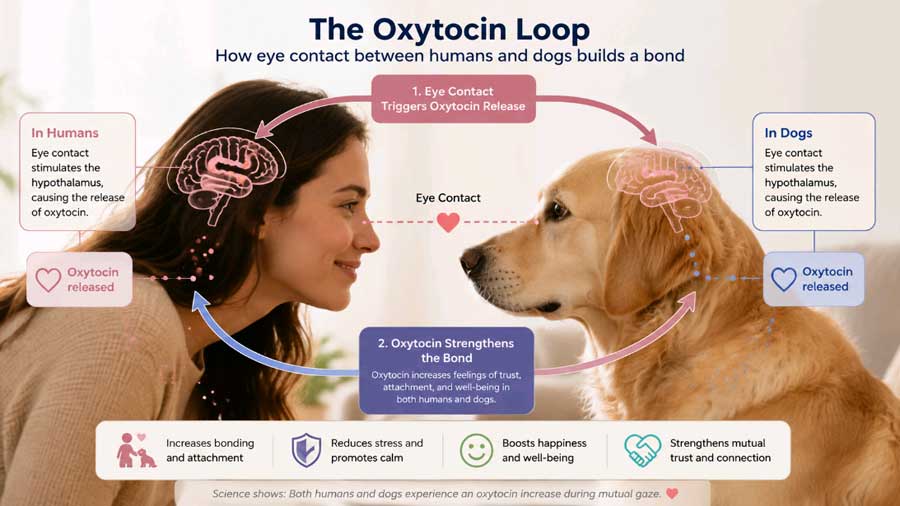
When you and your dog make eye contact, both your brains release oxytocin — the same hormone that spikes between parents and infants. [A Study on the Oxytocin Gaze Cycle in Dogs] found that this loop runs both ways. Your dog isn’t performing affection. Their biology is responding to yours, in real time.
This is why a long stare from your dog feels different from a stare from a stranger’s dog. The chemistry is built on repeated exposure and trust, not instinct alone.
Attachment, Not Romance
Behavioral scientists describe the dog-owner bond using attachment theory — the same framework used to study human infants and caregivers. Dogs show secure-base behavior: they explore more confidently when their person is nearby and get visibly unsettled when separated in unfamiliar settings.
That’s not romantic love. It’s something arguably more durable — a survival-level bond that doesn’t require words to function.
Can Dogs Sense Human Emotions Even When You Hide Them?
Yes, and better than most people expect.
Dogs read facial muscles, vocal pitch, and posture changes faster than they read words. Studies on canine emotion recognition show dogs can distinguish a genuine smile from a flat expression, and calm speech from tense speech — even without visual cues.
This explains why dogs often act “off” right before you consciously register your own stress. They’re not psychic. They’re just paying closer attention to your body than you are.
Why This Matters for Multi-Pet or Multi-Person Households
If your dog seeks out one family member during conflict or stress, that’s not favoritism for no reason. It usually means that person’s baseline energy reads as more predictable or calm to the dog.
7 Signs Your Dog Actually Understands and Feels Love
These go beyond tail wags. Each one ties back to a real behavioral or physiological signal.
- Sustained, relaxed eye contact — triggers the oxytocin loop mentioned above
- Leaning into you — a calming behavior, not just physical contact
- Following you room to room — proximity-seeking tied to secure attachment
- Loose, wiggly body language (not stiff or frozen) — indicates comfort, not tension
- Bringing you objects unprompted — a resource-sharing behavior rooted in trust
- Settling calmly near you instead of pacing — shows your presence lowers their arousal
- Seeking you out specifically during stress — you’re their regulation point, not just a comfort object
When It’s Not Love — It’s Anxiety
This is the part most articles skip, and it matters.
Not every clingy behavior is affection. Some of it is separation anxiety, and mistaking one for the other can delay real help your dog needs.
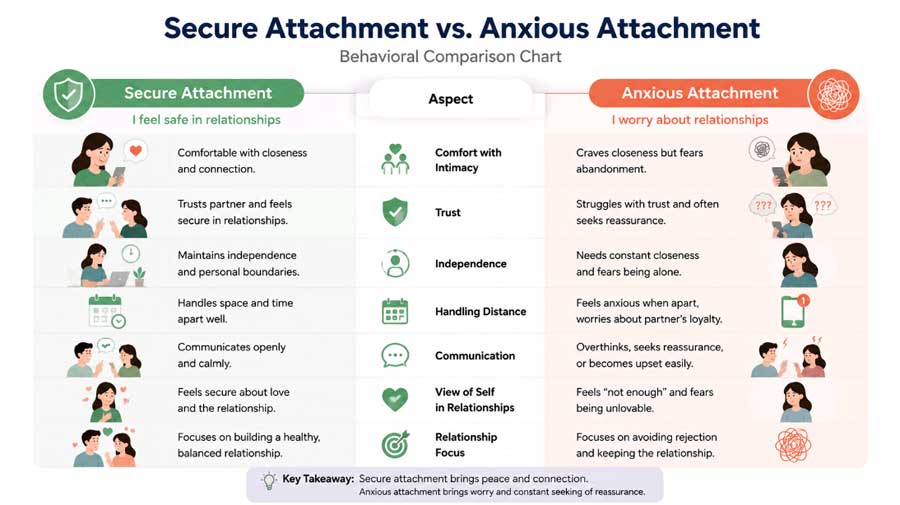
Signs of Secure Attachment vs. Anxious Attachment
| Behavior | Secure Attachment | Anxiety-Driven |
|---|---|---|
| Following you | Occasional, relaxed | Constant, can’t settle without you |
| Being left alone | Settles within minutes | Barking, destruction, pacing |
| Body language | Loose, soft | Stiff, panting, drooling |
| Greeting you | Excited, then calms | Frantic, doesn’t calm down |
| Physical closeness | Chosen, not forced | Panicked if separated |
If your dog’s behavior matches the right column consistently, this isn’t about love at all — it’s a welfare issue. [How to Recognize and Deal with Separation Anxiety in Dogs] can walk you through next steps.
A board-certified veterinary behaviorist (DACVB) should be your first call if you see destructive behavior, self-injury, or nonstop vocalizing when you leave. This isn’t something to train away with more treats — it often needs a structured behavior plan, sometimes alongside veterinary support.
Does Breed or Past Experience Change How Dogs Show Love?
Yes, noticeably.
Primitive breeds like Shiba Inus or Huskies tend to show affection with more independence and less physical clinginess. Retrievers and other people-oriented breeds tend to be more overtly demonstrative. Neither is “more loving” — the wiring is just different.
Rescue dogs are a separate case. Trust-building after neglect or multiple homes takes longer, sometimes months. Expecting instant bonding sets both of you up for disappointment. [A Complete Guide to Building Trust with Rescue Dogs] covers realistic timelines if you’ve recently adopted.
How to Build a Stronger, Science-Backed Bond
Skip the grand gestures. Consistency beats intensity every time.
Be predictable. Dogs bond faster with owners whose reactions are consistent, not owners who give the most treats.
Use positive reinforcement. Reward-based training builds trust because it removes fear from the equation — this is backed by decades of applied behavior research, not just personal preference.
Prioritize calm touch over hype. Long, slow petting sessions lower cortisol in both dog and owner. Excited play matters too, but calm contact is what builds the deeper bond.
FAQ: Common Questions About Dogs and Love
Can dogs understand the words “I love you”?
Not the literal meaning, but they recognize the soft tone, relaxed posture, and gentle voice that usually go with it. The emotional signal lands even if the words don’t.
Do dogs know when you’re upset with them?
They pick up on your tone and body language shift, but they don’t connect it to a specific past action the way a person would. They’re reading your current state, not replaying the event.
Can dogs bond more with one person over others?
Yes. It usually comes down to who spends the most calm, consistent time with them — not who gives the most attention in bursts.
How long does it take a new dog to bond with its owner?
For puppies, a few weeks. For rescue dogs, anywhere from a few months to over a year, depending on their history. Patience matters more than technique here.
Do dogs feel guilty when they misbehave?
That “guilty look” is actually a fear response to your tone or body language, not remorse. They’re reacting to you, not reflecting on what they did.
The Bottom Line
Dogs don’t love the way we do, but the bond is real, measurable, and built on trust you can actually strengthen. Watch for the difference between genuine attachment and anxiety, stay consistent, and the science backs up what most owners already feel: your dog knows you, and that knowing runs deep.
Disclaimer: This article is for informational purposes only and does not replace professional veterinary or behavioral advice. If your dog shows signs of anxiety, distress, or behavioral changes, consult a licensed veterinarian or certified veterinary behaviorist.